Mainstream formulas
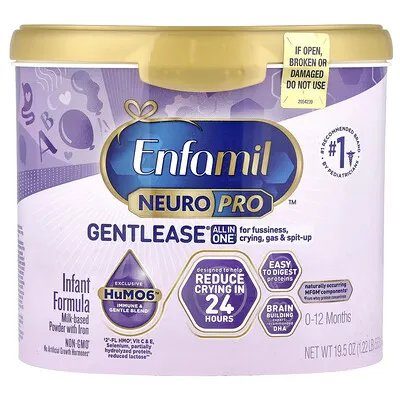
Enfamil Gentlease NeuroPro Powder (27.4 oz) — Enfamil (Mead Johnson Nutrition)
Draft · Unpublished
| Product | Enfamil Gentlease NeuroPro Powder (27.4 oz) |
|---|---|
| Maker | Enfamil (Mead Johnson Nutrition) |
| Category | Mainstream formulas |
| Size / format | Birth to 12 months. 27.4 oz powder can (also 12.4/19.5 oz cans and 2/8/32 fl oz RTF). |
| Observed price | $52.99 |
| Price source / date | Target · 2026-09-22 |
| Price confidence | indexed |
| Recall status | No exact-model recall found in consulted sources for window 2023-09-22 to 2026-09-22. CPSC database not directly queryable via available tools — status is unchecked, never cleared. |
When a baby screams through the evening and nothing helps, parents don't want a philosophy — they want the thing that works. Enfamil Gentlease NeuroPro is the thing that works for a lot of them. It's the gentle-digestion formula with the biggest evidence base in America: partially hydrolyzed proteins, DHA plus MFGM for brain development, and a clinical claim of reduced fussiness, gas, and crying within 24 hours. Thirty-seven thousand Target ratings at 4.8 stars. This isn't the trendy pick. It's the default pick, and defaults exist for reasons.
The formula's mechanics are straightforward. Partially hydrolyzed proteins are pre-broken, so immature digestive systems handle them with less gas and spit-up. The NeuroPro tier adds MFGM — milk fat globule membrane, a component of breast milk linked to brain development — alongside DHA, which is table stakes at this price. Parents in the aggregated reviews report the same arc over and over: switched from a standard formula, gas and spit-up diminished, colic-like symptoms eased, sleep improved. Some families praise its effectiveness across multiple children — the strongest signal a formula review corpus can give.
What's genuinely good, beyond the formula itself, is the availability infrastructure. Every Target, Walmart, and grocery store in America stocks it. WIC covers Enfamil in many states, which matters enormously for the families feeding on a budget. And the line spans powder, ready-to-feed bottles, and large refill boxes — the 27.4 oz powder can at $52.99 is the value play; the 2 oz ready-to-feed bottles are the 3 a.m. survival play.
What's actually wrong is mostly money and honesty about claims. Fifty-three dollars for a 27.4 oz can is premium pricing, and the reviews' number-one complaint is the cost — parents emphasize the investment is worthwhile, which is what people say when the investment hurts. The 24-hour relief claim is real as a clinical finding but varies wildly by baby; it is not a colic treatment, and for some infants it changes nothing. The ready-to-feed formats, while brilliant at 3 a.m., cost more per feed and generate single-use plastic waste — the standard RTF tradeoff, noted here by motherbabykids. And the aggregated review sources (Ubuy's editorial pages) are marketplace-adjacent content, so treat the praise as directionally right rather than independently verified.
The social pulse is utilitarian rather than passionate. Nobody's tattooing the Enfamil logo; it's the formula in the group chat reply that says "gentlease worked for us, hope it works for you." That's a quieter signal than the import-formula enthusiasm, but at 37,000+ ratings it's a louder dataset. The price grumbling is constant and honest — this is the formula people wish were cheaper, not the formula people regret buying.
The value call: at $1.93/oz it's meaningfully more than store-brand gentle formulas (up&up's non-GMO hypoallergenic runs ~$1.65/oz) and roughly on par with Similac's sensitive lines. You're paying for the MFGM/DHA stack and the deepest clinical pedigree in the category. Against the European imports (HiPP HA at ~$42/600 g), Enfamil is cheaper per ounce, domestically available, and WIC-eligible — the imports win on ingredient philosophy, Enfamil wins on logistics.
Skip it if your baby is fine on a standard or store-brand formula — don't pay the premium for a problem you don't have. Buy it if evenings are miserable and your pediatrician nods: it's the highest-probability first switch in American pediatrics, and the 24-hour claim means you'll know fast whether it's working. The honest tradeoff: the most proven gentle formula in the US, at a price that stings and a promise that sometimes doesn't land.
Two caveats round it out: the "24 hours" relief claim is the maker's — individual babies vary, and it's not a colic treatment. And the ready-to-feed formats trade convenience for single-use packaging waste, as motherbabykids notes. Powder is the economical, lower-waste default.