Toddler snacks/drinks
enfagrow premium toddler drink
Draft · Unpublished
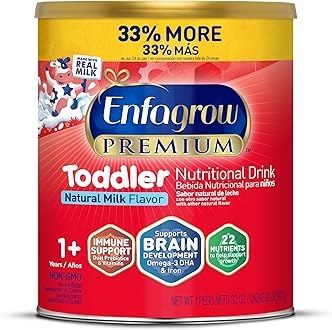
| Product | enfagrow premium toddler drink |
|---|---|
| Maker | — |
| Category | Toddler snacks/drinks |
| Size / format | 32 oz powder canister (flagship); 8 oz RTD bottles separate. |
| Observed price | $29.86 / 32 oz (Amazon indexed, crawl 231 days - stale-risk) |
| Price source / date | Amazon · 2026-09-20 (index crawl 231 days old) |
| Price confidence | indexed_stale_risk |
| Recall status | No active recall found. |
The AAP has thoughts about this can, and you should hear them before the marketing. In October 2023, the American Academy of Pediatrics put out a clinical report on toddler "formulas" — and the headline was blunt: these products offer no nutritional advantage for most children over a balanced diet, and they're not regulated the way infant formula is. Enfagrow is the biggest can in that category. This review is about the gap between what the can promises and what the pediatricians say.
What it is: a toddler nutritional drink powder for ages 1–3 — not infant formula, and the distinction is regulatory, not just semantic. The researched format is the 32 oz powder canister with DHA, prebiotics, and a vitamin/mineral panel positioned for toddlers. (Mead Johnson also sells 8 oz ready-to-drink NeuroPro bottles — a different format; don't merge them.)
What's genuinely good: the owner base is large and satisfied — 4.7 out of 5 across 2,689 Amazon reviews (indexed), which describes a lot of parents who feel good about this purchase. The specific use case is real: parents of picky toddlers value the nutritional backstop, the insurance policy in a can for the kid who currently eats beige foods in a narrow rotation. For that family, on that week, the reassurance has genuine value — parental anxiety about nutrition is real, and a product that reduces it isn't nothing.
What's actually wrong: the AAP guidance is the core caveat and it doesn't mince words — for most toddlers eating a reasonably balanced diet, this product adds nothing nutritionally. That's the pediatric establishment's position, not a fringe take, and it reframes the entire value proposition: you're buying reassurance, not nutrition. The "toddler formula" category exists in a regulatory gap — marketed with formula-adjacent language, without infant formula's regulatory framework — which is exactly what the AAP report was criticizing. The price ($29.86 for 32 oz on Amazon) rests on a 231-day-old crawl — stale-risk, so verify live. And the evidence is moderate: individual review text wasn't sampled, so the "picky toddler backstop" theme comes from the aggregate, not from reading the reviews. Skip it if your toddler eats a varied diet — the pediatricians are clear on this one, and the money is better spent on actual food. Consider it only for the genuinely picky eater, and even then, talk to your pediatrician first — that's not boilerplate, that's the AAP's actual recommendation context.
The social pulse: Enfagrow sits at the center of the toddler-drink debate the AAP report ignited. On one side: parents of picky eaters who swear by it, with the 2,689-review aggregate behind them — the "my kid won't eat, this helps me sleep" constituency, which is sympathetic and real. On the other: pediatricians and the parents who've read the report, arguing it's an expensive solution to a problem most toddlers don't have, marketed to parental anxiety. The debate is really about whether "nutritional insurance" is a legitimate product category or a manufactured need. No hype flags surfaced in the ad-spend sense — this sells on worry, not influencers, and worry is the most reliable marketing there is.
Value call: at roughly $30 for 32 oz (stale-risk — verify live), it's priced like a premium pantry staple for something the AAP says most kids don't need. Against actual food, the math is brutal: $30 buys a lot of groceries. Against the anxiety of the beige-food years, some parents will pay it gladly. The straight answer: if your pediatrician recommends it for your specific picky eater, it's a reasonable purchase at a documented-ish price. If you're buying it because the can implies toddlers need it — they don't, per the pediatricians, and that's the whole review.
A backstop for the picky-eater years, not a necessity — and on this one, the pediatricians outrank the packaging.
Sources
No standalone source URLs with retrieval records were captured for this entry — sources are cited inside the research text above.