Montessori toys
PlanToys Sort & Count Cups — PlanToys
Draft · Unpublished
| Product | PlanToys Sort & Count Cups |
|---|---|
| Maker | PlanToys |
| Category | Montessori toys |
| Size / format | ~3.31 x 3.31 x 1.38 in (cups); ages 18m+ (maker). |
| Observed price | $29.99 |
| Price source / date | Nordstrom · 2026-09-22 |
| Price confidence | indexed |
| Recall status | No exact-model recall found in consulted sources for window 2023-09-22 to 2026-09-22. CPSC database not directly queryable via available tools — status is unchecked, never cleared. |
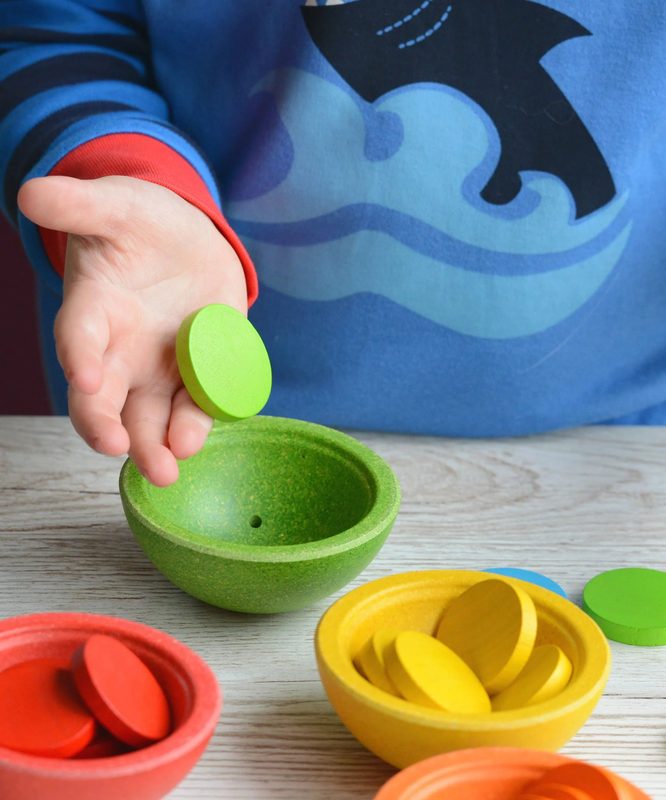
The PlanToys Sort & Count Cups are five colored wooden cups with matching colored chips in a cotton bag — and that's the whole toy. Sort the chips by color into the cups. Toss them in from a distance. Invent your own counting games. It's the Montessori sorting exercise in its purest form, made from sustainable rubberwood with non-toxic dyes, and it's praised by educators as a leading tool for early learning play.
What it is: 5 colored rubberwood cups plus matching colored chips/tokens (listings conflict: 5 or 25 — count on arrival) in a cotton storage bag, with play instructions. Sort by color, practice counting, build patterns. Ages 18 months+. No batteries.
What's genuinely good is the multi-way play from a simple set. Sorting by color is the entry point; tossing chips into cups from a distance adds gross-motor challenge; inventing games adds creativity. The one-to-one correspondence (matching chip to cup by color) is foundational math, and the patterning/sequencing extensions give it legs past age 2. The rubberwood construction is the PlanToys signature: sustainable, chemical-free, smooth, no sharp edges. The cotton bag is the parental feature — everything has a home.
What's actually wrong is the piece-count confusion. Nordstrom says 25 tokens; Australian listings say 5 chips. That's a meaningful difference (5 chips = a 2-minute activity; 25 = a real sorting session), and buyers should verify what's in the box. The chips are small — the bag habit is essential, and 18-month-olds will mouth them. And it's a simple toy with a natural ceiling: by 3, most kids have exhausted the sorting and moved to more complex games.
Who it's for: the 18–30-month sorting phase, Montessori classrooms, and the eco-conscious buyer who wants reclaimed rubberwood over plastic. Who should skip: under-18-month mouthers (the chips are small), and kids past 3 who've exhausted sorting — the ceiling is real.
The piece-count question is the buying decision, so settle it: Nordstrom says 25 tokens, Australian listings say 5 chips, and that's the difference between a 2-minute activity and a real sorting session. Count on arrival and treat the listing as guilty until proven innocent — the record flags this as an unresolved conflict, not a typo. At $29.99 (Nordstrom; $37.49 AUD) it's boutique-priced against plastic sorting toys, and the rubberwood-plus-bag build is what justifies it. MSRP unverified on plantoys.com. Warranty: UNVERIFIED. No batteries, bag included — the bag is the whole retention system, so use it.
The social pulse is Montessori-classroom standard. PlanToys is the sustainable-wood brand, and sorting sets like this are classroom staples — they show up in "best sorting toys for toddlers" roundups and homeschooling lists as the eco pick. The educator praise (Nordstrom's copy cites it) is the credential. Resale moves steadily; rubberwood holds up.
Value call: at $29.99 (Nordstrom) it's fairly priced for a sustainable-wood sorting set — though verify the token count before buying, since that determines the play value. For an 18–30-month-old, it's one of the best pure sorting toys. Buy it for the second year; expect the sorting phase to last 12–18 months.
The cotton storage bag is the small detail that decides whether this gets played with: five cups and a pile of chips in a bag is a grab-and-go activity; loose, they're clutter. The multi-way play is the longevity: sort chips by color into matching cups, practice one-to-one correspondence, invent counting games, build towers, use the cups for water play. The rubberwood construction with non-toxic water-based dyes is PlanToys' sustainability story — rubberwood is reclaimed from rubber plantations past their latex-producing life. At $29.99, it's priced against the boutique end of sorting toys, and the bag plus the wood quality justify it against plastic alternatives that crack and fade within a year.
Closing line: five cups, a bag of chips, and the foundations of math — the sorting toy that earns its educator praise.