Swings, jumpers & activity centers
Baby Einstein Journey of Discovery Jumper — Baby Einstein (Kids2)
Draft · Unpublished

| Product | Baby Einstein Journey of Discovery Jumper |
|---|---|
| Maker | Baby Einstein (Kids2) |
| Category | Swings, jumpers & activity centers |
| Size / format | 34 x 36.7 x 36.7 in; ages 6–12 months (maker). |
| Observed price | $99.99 |
| Price source / date | Kids2 (official; $89.99 at DealsNPromos; used $23–75) · 2026-09-22 |
| Price confidence | indexed |
| Recall status | No exact-model recall found in consulted sources for window 2023-09-22 to 2026-09-22. CPSC database not directly queryable via available tools — status is unchecked, never cleared. |
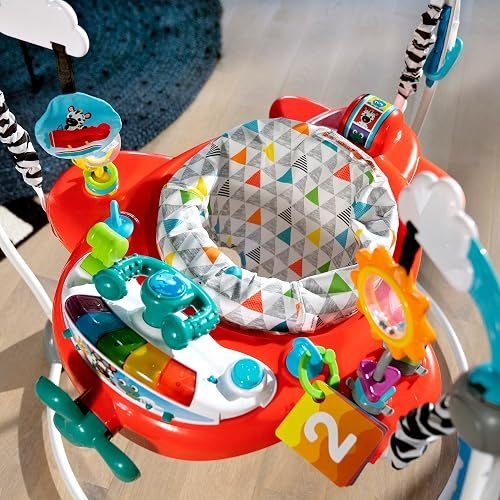
The Baby Einstein Journey of Discovery Jumper turns the standard activity jumper into a travel expedition: 12 activities themed around the globe, a spinning globe that plays international music and speaks three languages, a bead-chasing snowman at the North Pole, Baby Neptune under the sea. The 360° seat rotates so the baby can hit every station. Ages 6–12 months.
What it is: a stationary activity jumper with 12 travel-themed activities, a spinning multi-color globe (international music, instrument names, 3 languages), 360° rotating bouncy seat, 4 height positions, machine-washable seat pad, and high seat back. 34 × 36.7 inches. Requires 3 AA batteries (not included).
What's genuinely good is the activity density. Twelve stations is a lot — the globe alone (music + languages + spinning) buys extended engagement, and the 360° rotation means the baby self-directs instead of waiting to be turned. Four height positions extend the 6–12-month window as the baby grows. The machine-washable seat pad is the practical win — jumper seats get disgusting. The travel theme is genuinely charming without being saccharine.
What's actually wrong is the footprint and the window. At 36.7 inches square it's a big piece of baby furniture for a 6-month usable window. The 3 AA batteries not included is the standard annoyance. And the eternal jumper caveat: these are for short supervised sessions, not all-day containment — pediatric guidance favors floor time for development, and jumpers are a supplement, not a substitute.
Who it's for: the 6–10-month head-up window, and the first-baby registry pick you'll hand down — buying new at $99.99 only makes sense if there's a next kid in line. Who should skip: anyone expecting all-day containment (short supervised sessions only; floor time is the developmental priority), and small living rooms — 36.7 inches square is furniture for a 6-month window.
The resale math is the buying decision: $23–$75 used (Karrot, Alaska's List, Nellis) against $99.99 MSRP verified on kids2.com — jumpers are mechanically simple, so used is fine; wash the seat, check the springs. The 4 height positions stretch the window as the baby grows. Three AAs not included — keep spares. Warranty: UNVERIFIED. Against doorway jumpers, the stationary format is the safer pick: no doorframe mounting, no clearance worries, and the high seat back adds support.
The social pulse is established-activity-gear standard. Baby Einstein jumpers are the default activity-jumper pick — they appear in "best activity centers" roundups and registry guides consistently. The resale market is active (Karrot $23, Alaska's List $75), which confirms both popularity and the short window — these are classic secondhand buys.
Value call: at $99.99 it's fairly priced for a 12-activity jumper with this build — but the used market at $23–75 is the value play, and jumpers are mechanically simple enough that used is fine (wash the seat, check the springs). For a 6–10-month-old, the activity density is the differentiator. If you want the jumper category, buy this used; if you want new, $99.99 is fair.
The buying window is specific: 6–12 months, once the baby holds their head up steadily and before they can climb out or walk — miss it and you've bought furniture. The four height positions stretch that window as the baby grows. The 3 AAs not included is the standard annoyance; keep spares. Against doorway jumpers, the stationary format is the safer pick — no doorframe mounting, no clearance worries, and the high seat back adds support. Against the Fisher-Price jumperoo line, the travel theme and the globe with three languages are the differentiators. The resale math is the real story: $23–$75 used for a 6-month window means buying new at $99.99 only makes sense if it's a gift or a first-baby registry pick you'll hand down to the next kid in line.
Closing line: twelve stations, three languages, one spinning baby — the world tour that fits in the living room.