Kids' wearables & health tech
Kinsa QuickScan Smart Thermometer — Kinsa Health
Draft · Unpublished
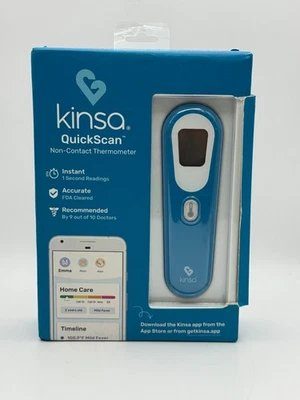
| Product | Kinsa QuickScan Smart Thermometer |
|---|---|
| Maker | Kinsa Health |
| Category | Kids' wearables & health tech |
| Size / format | One size; doctor-recommended for all life stages, from newborn to adult. |
| Observed price | $49.99 |
| Price source / date | kinsahealth.com (reported: Amazon $36.99 via 2023 review; CVS $42.99) · 2026-09-22 |
| Price confidence | indexed |
| Recall status | No exact-model recall found in consulted sources for window 2023-09-22 to 2026-09-22. CPSC database not directly queryable via available tools — status is unchecked, never cleared. |
The Kinsa QuickScan is the best argument that a thermometer can be more than a thermometer: a one-button, no-contact forehead reader with a backlit LCD, paired over Bluetooth to a genuinely well-designed free app that turns a fever reading into personalized guidance — what to do next based on the child's age, the fever, and logged symptoms; medication tracking and reminders; family profiles; illness timelines you can share with the pediatrician; Apple Health sync. No subscription. Works without the app too. FDA-cleared, FSA/HSA-eligible, $49.99, 1-year warranty, two included AAA batteries. The hardware and software reviewers (9to5Mac) loved it.
But this is one of the batch's real accuracy debates, and it needs to be stated plainly. AppleInsider gave it 3.5/5 and ShopSavvy's cross-retailer aggregate lands at 6.9/10, driven by users reporting significant discrepancies against traditional thermometers, plus the lack of on-device memory recall and occasional app crashes. CVS reviews show both poles: "Not accurate, waste of $45" alongside "Love the app tracking!" The pattern is consistent: the app and guidance experience are excellent; the raw reading is the thing some owners distrust. FDA clearance means it passed stated accuracy standards — it doesn't mean it'll always match your rectal thermometer, which remains the clinical gold standard for infants.
The use case where the QuickScan genuinely earns its place is the multi-person household. The app stores data for multiple users with individual profiles, tracks symptoms and medications per person, and shows the fever-indication icons (a smiley for normal, a frown for fever) right on the backlit LCD — so a bleary-eyed parent at 3 a.m. gets an instant read on whether this reading is in-range without parsing numbers. Two AAA batteries power it with no rechargeable-battery anxiety, and it works as a standalone thermometer without the app at all — the app is the upgrade, not the requirement. FSA/HSA eligibility takes the sting out of the $49.99 for American buyers.
The accuracy debate needs one more layer of honesty. No-contact forehead thermometers are inherently noisier than contact probes: room temperature, sweat, forehead distance, and movement all introduce variance, and the maker's own guidance (aim at the center of the forehead from 1 inch away) is doing real work to keep readings consistent. The ShopSavvy aggregate's complaints about discrepancies against traditional thermometers are consistent with how this sensor class behaves — not necessarily a Kinsa-specific defect. Which is also why the "keep a probe thermometer alongside" advice isn't hedging: it's how pediatricians actually use these devices, as a screening tool with a contact thermometer as the confirmatory one. The occasional app crashes and the must-pair-before-first-use requirement are the annoyances to know about going in, not dealbreakers.
Who should buy it: families who want fever management (guidance, tracking, records) rather than just a number — especially parents of kids who won't sit still for a probe. Who shouldn't: parents who need a single trusted number in a 3 a.m. fever moment. For that, keep a basic probe thermometer alongside.
Price note: $49.99 from Kinsa; Amazon's $36.99 figure is from a 2023 review (stale), CVS lists $42.99, and ShopSavvy's $9.99 Best Buy listing looks like a clearance anomaly.
Gaps, disclosed: no Threads owner evidence; Facebook groups weren't searched per item; social layer thin. No exact-model recall found in consulted sources for window 2023-09-22 to 2026-09-22. CPSC database not directly queryable via available tools — status is unchecked, never cleared.