Kids' wearables & health tech
Jiobit Smart Tag Location Monitor — Jiobit / Life360
Draft · Unpublished
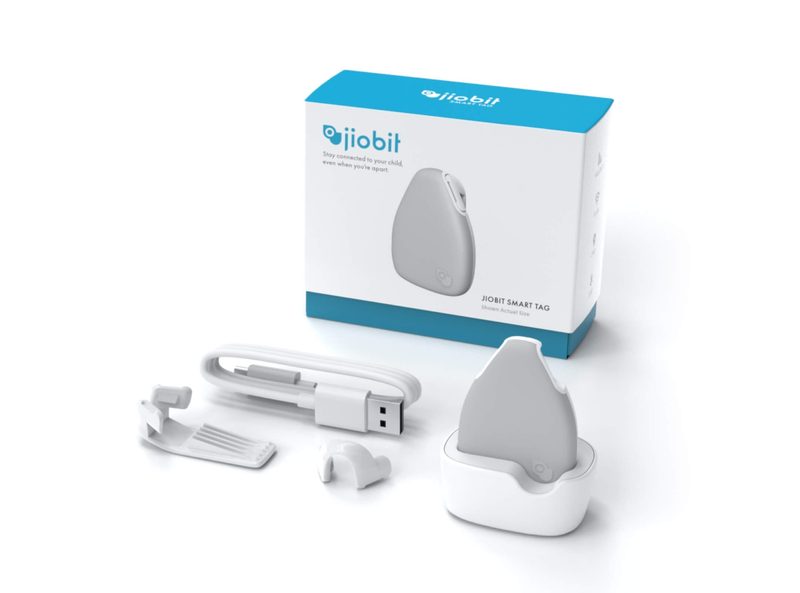
| Product | Jiobit Smart Tag Location Monitor |
|---|---|
| Maker | Jiobit / Life360 |
| Category | Kids' wearables & health tech |
| Size / format | One size; sugar-packet size for toddlers, kids, pets, seniors; sensory-friendly small size. |
| Observed price | $129.99 |
| Price source / date | Jiobit (discounted; list $149) · 2026-09-22 |
| Price confidence | indexed |
| Recall status | No exact-model recall found in consulted sources for window 2023-09-22 to 2026-09-22. CPSC database not directly queryable via available tools — status is unchecked, never cleared. |
The Jiobit Smart Tag answers a narrower question than every smartwatch in this category: where is my child, right now, with no phone involved? It's 18 grams of GPS+cellular+Wi-Fi+Bluetooth tracking with no screen, no mic, no speaker — a sugar-packet-size tag that clips to a belt loop, backpack, shoe, or necklace. Real-time location with unlimited range, geofencing with unlimited custom zones, departure/arrival alerts, speed alerts, and the standout feature: care-team sharing that shows not just where your child is but who they're with, by connecting with caregivers' phones over Bluetooth. IPX8 waterproof, shockproof enough that Tom's Guide testers threw it on the ground, stepped on it, and left it in a rain shower without killing it.
The economics are the honest barrier: ~$129.99–$149 for the device plus a subscription ($8/mo with a 1-year commitment, $99.99/yr prepaid, up to $17/mo without) — roughly $230 the first year and ~$350 over two years at list. A 2026 comparison frames the tradeoff cleanly: against an AirTag ($29, no subscription, but not real GPS — entirely dependent on nearby Apple devices), Jiobit is the better kid tracker if your child walks to school, takes a bus, or spends time away from populated areas; the AirTag wins only as a cheap lost-item safety net.
The limits are structural: no calling, no messaging, no SOS button — location only. Battery life is the top parent complaint; "up to a week" is best-case and Live View pings shorten it fast. And one important availability caveat from the 2026 comparison: new-device availability now needs a current check (Jiobit is under Life360 ownership) — verify it's actually purchasable before recommending.
The care-team sharing is the feature reviewers keep coming back to, and it's worth explaining because it's genuinely unusual. The Jiobit app lets multiple caregivers — parents, grandparents, babysitters — all see the tracker's location, and when a caregiver's phone is near the tracker, Bluetooth pairing tells the app who the child is with. So instead of "she left school at 3 p.m." you get "she left school at 3 p.m. with her dad." For shared-custody families and multi-caregiver households, that's the difference between a location dot and actual reassurance.
The security posture is the other differentiator. The TrustChip delivers encryption that meets or exceeds US-government standards — overkill-sounding until you remember this is a device that broadcasts a child's real-time location. In a category where cheap Bluetooth finders have had real privacy problems, the encryption story is a legitimate buying criterion, not spec-sheet padding.
The 2026 comparison's availability warning deserves repeating as the closing caveat: Jiobit's new-device availability needs a current check before purchase (the company is under Life360 ownership now), so verify the product is actually purchasable and supported before building plans around it. And the battery reality check: "up to a week" is best-case — plan a charging cadence that survives a school week, and budget extra charging when Live View or weak coverage is in the routine. A dead tracker on dismissal day is worse than no tracker, because you trusted it.
Best use case: the independent-walker years (6–10) where a phone is too much and a Bluetooth tag isn't enough. Worst use case: parents who want two-way emergency communication — get a TickTalk or Gizmo instead.
Gaps, disclosed: no Threads owner evidence; Facebook groups weren't searched per item; social layer thin. No exact-model recall found in consulted sources for window 2023-09-22 to 2026-09-22. CPSC database not directly queryable via available tools — status is unchecked, never cleared.