Bilingual & learning systems
Lunii My Fabulous Storyteller — Lunii (France)
Draft · Unpublished
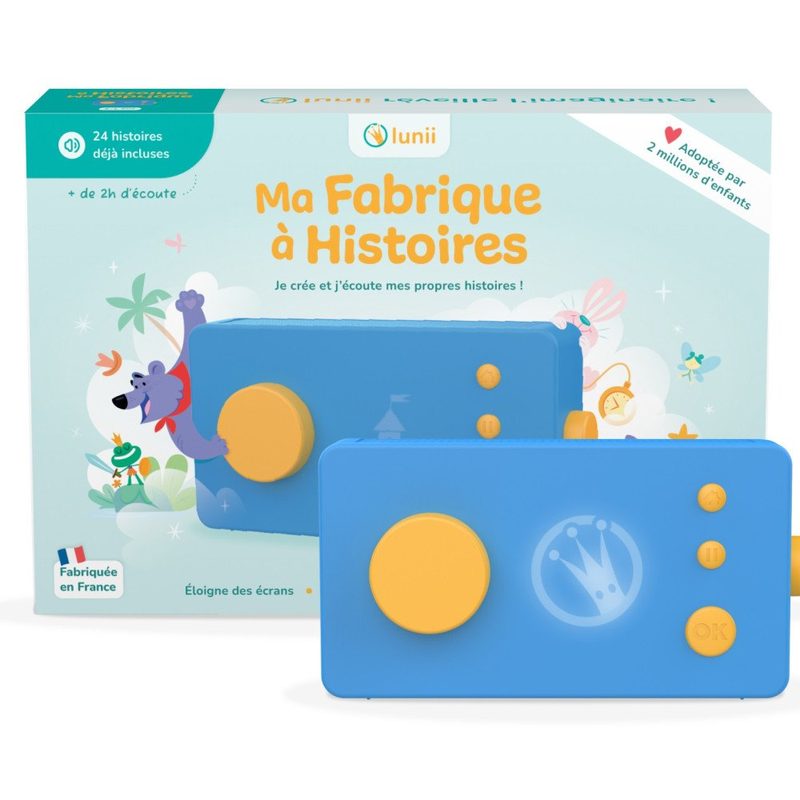
| Product | Lunii My Fabulous Storyteller |
|---|---|
| Maker | Lunii (France) |
| Category | Bilingual & learning systems |
| Size / format | Ages 3–8; small portable device; choking-hazard warning for under 3s (small parts) per Swiss retailer. |
| Observed price | UNVERIFIED (UK ~£50–£69.90; CAD $119.99; CHF ~79.90 — no current US price verified) |
| Price source / date | UNVERIFIED — no US retailer price found in consulted sources · 2026-09-22 |
| Price confidence | indexed |
| Recall status | No exact-model recall found in consulted sources for window 2023-09-22 to 2026-09-22. CPSC database not directly queryable via available tools — status is unchecked, never cleared. |
Four French friends started Lunii with one goal: keep children away from screens. The My Fabulous Storyteller is the result — a small, sturdy, turquoise box that lets kids build their own audio stories by turning dials to choose a hero, a place, a companion, and an object, then listens back to the tale they created. No screen, no waves, no feed. And kids are, by every parent-blog account, obsessed with it.
How it works in practice: switch it on, a voice walks the child through the choices, and an LED silhouette on the front lights up with each option — a gentle glow that doubles as a night light. Forty-eight stories come preloaded, and the Luniistore (desktop app, Mac/Windows/Linux on the original model) offers hundreds more in 8–9 languages, with albums from €2.90 to €19.90 and some free. Battery runs about 10 hours, it auto-sleeps after five idle minutes, charges over USB, and there's a headphone jack for the car/plane/sibling-nap scenarios.
What parent reviewers report across multiple UK blogs: kids listen intently. Not background-play intently — choose-your-own-adventure, argue-about-the-plot intently. One reviewer watched her boys, particularly her younger one, get completely absorbed in building and rebuilding stories. Parents love that it's genuinely interactive rather than passive — the child authors the story, which is a different cognitive activity than being read to or watching something. The multilingual households are a sweet spot: families download stories in Spanish, French, Italian alongside English. And the durability reports are good — "strong and sturdy, perfect for small hands, will withstand being dropped."
The honest caveats. First, it's not a bedtime-story replacement, and the reviewers say so explicitly — it's an addition, a treat, a travel companion. Don't buy it expecting to retire yourself from reading duty. Second, the content treadmill: 48 stories last a while, but engaged kids will want more, and the Luniistore albums cost real money (€2.90–€19.90 each). Budget for it or lean on the free options. Third, content management on the original model requires a computer — no phone app, no Wi-Fi (that's the newer Story Factory model, a different product). Fourth, US availability and pricing are the weak spot in this record: Lunii is French, the crisp pricing is all UK/EU/CA/CH, and I couldn't verify a current US price — check before you fall in love. Fifth, under-3s: small parts, choking-hazard warning, ages 3–8 means 3–8.
The social pulse: warm, earnest, slightly evangelical. The parent-blog reviews read like converts — the screen-free ethos resonates hard with parents drowning in tablet guilt. There's even a hospital-charity angle: pediatric units using them for hospitalized kids, with nurses reporting unanimous approval. The competitive conversation is Lunii vs. Yoto vs. Toniebox, where Lunii's edge is the story-creation mechanic (the others are primarily playback devices) and its weakness is the less slick content ecosystem.
Value call: at ~£50–£70 in the UK it's fairly priced against Yoto and Toniebox; just factor in the album costs and verify US pricing/availability before committing. For a bilingual household or a screen-time-battling family, the value proposition is strong.
Bottom line: the rare kids' tech that reduces screen time instead of competing for it. Verify your region's price, budget for story albums, and keep reading the bedtime story yourself too.
The Lunii decision is really two decisions: the box and the content treadmill. The box is a one-time purchase that holds its value — screen-free, sturdy, multilingual, genuinely engaging. The albums are the ongoing cost, and engaged kids will work through the preloaded stories faster than you'd expect. Budget for it the way you'd budget for books: a few euros a month keeps the novelty alive, and the free options stretch further than the storefront suggests. The other choice is original versus Story Factory — the newer model adds Wi-Fi and an app, the original needs a computer for transfers. If the household runs on phones and tablets, the newer model's convenience is worth pricing out; if there's a laptop in the house, the original does the same job. Either way, buy it for the travel and quiet-time use case, where a screen-free story box earns its keep daily — and keep reading the bedtime story yourself.
Sources
No standalone source URLs with retrieval records were captured for this entry — sources are cited inside the research text above.