Family organization & routines
Time Timer MOD — Time Timer LLC
Draft · Unpublished
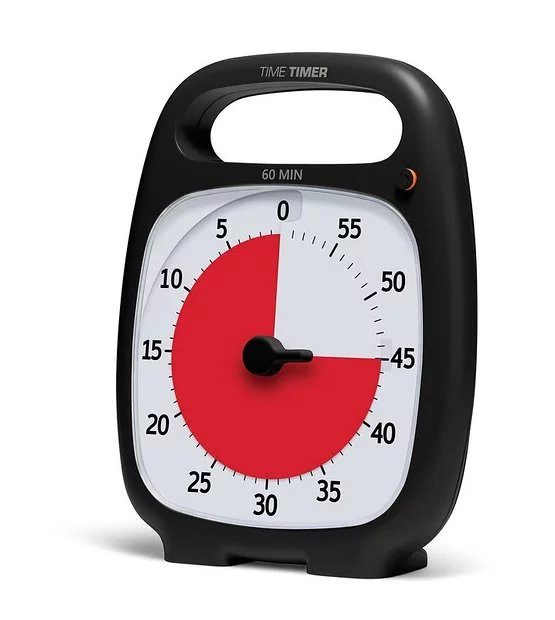
| Product | Time Timer MOD |
|---|---|
| Maker | Time Timer LLC |
| Category | Family organization & routines |
| Size / format | 3.5 x 3.5 in; all ages (manufacturer recommends adult handling). |
| Observed price | $19.95 (MOD Home Edition at Walmart; conventional MOD with silicone case priced separately — varies) |
| Price source / date | Walmart (Time Timer LLC seller) · 2026-09-22 |
| Price confidence | indexed |
| Recall status | No exact-model recall found in consulted sources for window 2023-09-22 to 2026-09-22. CPSC database not directly queryable via available tools — status is unchecked, never cleared. |
The Time Timer is one of those rare products that's also a concept: a red disk that disappears as time passes, giving kids (and adults) who can't read a clock an intuitive picture of time running out. Since 1994 it's been the standard visual timer in classrooms, therapy offices, and homeschools — and the MOD is the portable, kid-tough version: 60 minutes, 3.5 inches square, with a removable silicone case that survives being knocked off a desk. Amazon's Canadian listing holds 4.6 stars from 1,511 ratings, which for a timer is remarkable.
What's genuinely good: the visual countdown is the whole product, and it works across ages and abilities — the maker notes it "works across all languages and cultures," and its real stronghold is ADHD and autism support, where making time visible reduces the anxiety of transitions. The MOD's upgrades over the original are practical: the silicone case absorbs drops, the clear lens keeps sticky fingers off the disk, the operation is completely silent (no ticking — essential for sound-sensitive kids and classrooms), and the audible end-alert is optional via an on/off switch. The color-swap cases let kids personalize it, which sounds trivial until you watch a child choose "their" timer and then actually use it.
The honest caveats. First, the variant trap: the MOD Home Edition ($19.95 at Walmart) does NOT include the silicone case — it ships bare, and the cases are separate value packs. If you want the drop protection that makes the MOD the MOD, buy the conventional MOD, not the Home Edition. This is the single most useful thing in this review. Second, it needs one AA battery, not included — a small annoyance on a $20+ purchase. Third, the maker "recommends adult handling," which is honest: the disk mechanism isn't a toy, and curious fingers can jam it (hence the lens). Fourth, 60 minutes is the only range — for longer homework blocks or sleep training you'll reset it. Fifth, at $20–$30 it's premium for a timer when phone timers are free — you're paying for the visual format, which is exactly the point for kids who can't parse digits yet.
The social pulse: the Time Timer is the rare product with genuine professional credibility — occupational therapists, special-ed teachers, and ADHD coaches recommend it by name, and the parent community treats it as standard equipment rather than a gadget. The knockoffs ($14 visual timers on Walmart/Amazon) exist and get 3-star reviews; the Time Timer gets 4.6. The premium is for the mechanism that doesn't jam.
Value call: $19.95 for the Home Edition is fair if you don't need the case; the conventional MOD with the silicone case is the better buy for kids under 8 who will drop it. Against free phone timers: a phone timer teaches nothing to a 4-year-old; the red disk teaches time itself. For ADHD/autism households, it's assistive tech, not a gadget — price accordingly.
Bottom line: the original visual timer, still the best one — just make sure you're buying the MOD with the case, not the Home Edition without it.
The checkout checklist for this product has exactly one line: confirm the silicone case is in the box. The MOD Home Edition looks like the MOD, costs less, and ships without the case — which is the drop protection that makes the MOD the MOD for kids under eight. This is the single most expensive mistake in the category, and it's made constantly. Beyond that, match the timer to the setting: the silent operation and clear lens make it a classroom and therapy-office standard, where ticking would be a problem; at home, the value is the visual format for kids who can't parse digits yet. The one-AA-battery requirement (not included) is a minor annoyance worth knowing before the birthday-morning unwrapping. And set expectations honestly: the timer teaches the shape of time, not time management — the parent still runs the routine, the red disk just makes the routine visible. For ADHD and autism households, that's assistive tech, and it's priced like it.