Family organization & routines
SchKIDules Visual Schedule — SchKIDules
Draft · Unpublished
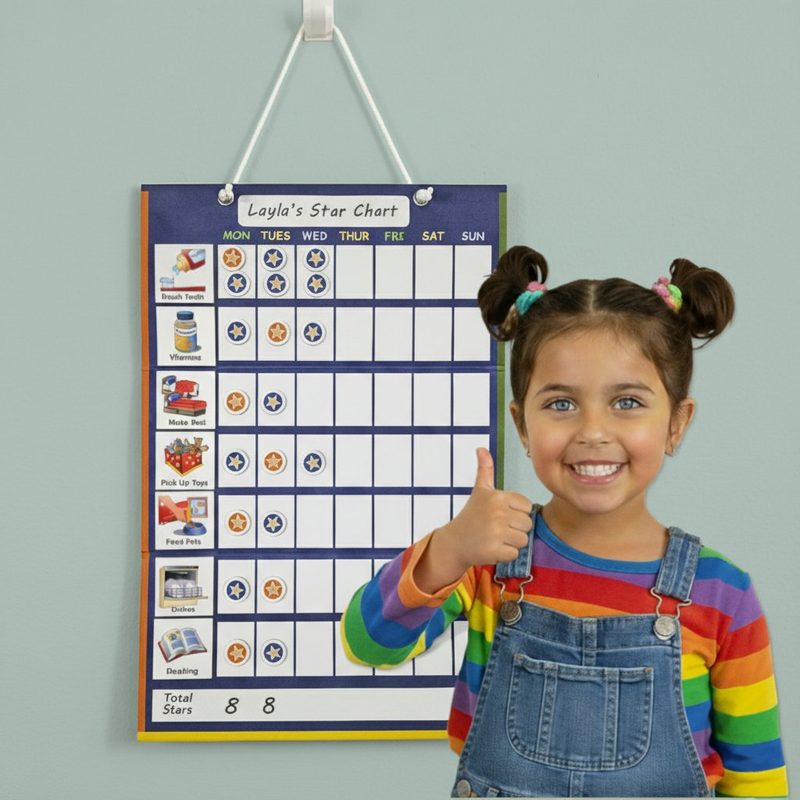
| Product | SchKIDules Visual Schedule |
|---|---|
| Maker | SchKIDules |
| Category | Family organization & routines |
| Size / format | 18 x 12 in board (folds to 6 x 12 in panels); ages 3–7. |
| Observed price | $32.99 (Home set, Giftpals) |
| Price source / date | Giftpals · 2026-09-22 |
| Price confidence | indexed |
| Recall status | No exact-model recall found in consulted sources for window 2023-09-22 to 2026-09-22. CPSC database not directly queryable via available tools — status is unchecked, never cleared. |
SchKIDules is the rare kids' product with professional credibility baked in: National Autism Resources sells it as a visual support — an evidence-based intervention for kids who melt down at transitions — and one reseller shows 754 reviews with 100+ sold in the past week. It's an 18-inch reversible tri-fold board: daily schedule on the blue side, weekly progress chart on the yellow, populated with 2x2-inch laminated magnets for activities, headings, and reward stars. For strong-willed, ADHD, autistic, or just transition-averse kids ages 3–7, it's the most complete magnetic-schedule kit at its price.
What's genuinely good: the reversibility and flexibility. The board folds into 6x12 panels, works horizontal or vertical, and supports at least six setups — daily schedules, to-do lists, First/Then boards (the single most effective behavior tool for young kids), and progress charts. The magnets are laminated and dry-erase friendly, so you can customize labels. No assembly; it hangs with the included nylon rope and works the minute it arrives. The Deluxe set's 132 activity icons across home, school, and special-needs categories means you're not stuck with generic pictures — autism-specific routines (sensory breaks, therapy sessions) get their own magnets. And the professional channel matters: when a special-needs retailer stakes its reputation on a product, that's a stronger signal than 754 gift-shop reviews.
The honest caveats. First, magnet counts vary wildly by set — 129 in the Home bundle, 123 in the Comprehensive, 189 in the Deluxe — and reseller listings mix them up freely. Confirm which set you're buying before comparing prices, because a $32.99 Home set and a $54.99 Deluxe set are different products. Second, it's a board, not a behavior plan: the visual schedule works when parents maintain it daily — move the magnets, flip to the weekly side, do the reward stars — and it becomes wall decor when they don't. The marketing copy promises more than cardboard can deliver. Third, at 18 inches it's a wall piece, not portable — for on-the-go routines you need the card-based systems instead. Fourth, ages 3–7 is the real window; older kids read the system as babyish. Fifth, small magnets + toddlers: the 2-inch magnets are chunky, but a determined 2-year-old will still pry them off, and they become projectiles — supervise.
The social pulse: SchKIDules lives in the special-needs parenting and homeschool communities, where visual schedules are standard equipment rather than a fad. It doesn't have the mainstream buzz of the Coogam responsibility chart (coming next in this batch) — it's the therapist's pick, not the influencer's. That quieter, professional endorsement is arguably worth more.
Value call: $32.99 for the Home set is genuinely good value — comparable magnetic schedule kits with fewer pieces sell for the same or more, and the professional endorsement is free credibility. The Deluxe at $45–$55 is worth it only if you need the school/special-needs icon range. Against DIY (printed cards + Velcro): SchKIDules saves you an afternoon of laminating and looks like something your kid will actually engage with.
Bottom line: the complete, therapist-trusted visual schedule kit — confirm your set's magnet count, then commit to maintaining it daily.
The set-confusion problem is the first thing to solve: Home, Comprehensive, and Deluxe have different magnet counts and different prices, and reseller listings mix them freely. Decide which icon range you need — the Deluxe's school and special-needs categories matter if that's your use case, otherwise the Home set is the value — then verify the listing matches before comparing prices. The second decision is the maintenance commitment, and it's the bigger one. A visual schedule is a daily practice: move the magnets, flip to the weekly side, run the reward stars. Done daily, it's an evidence-based support for transition-averse kids; done sporadically, it's wall decor. Be honest about which household you're in before buying. The First/Then board setup is the highest-value configuration for young kids — 'first shoes, then park' beats a full-day schedule for the under-five crowd. And keep it out of reach of determined toddlers; the magnets are chunky, but they're still projectiles.